
Fruit Fly Neuron Reconstruction
Reconstruct individual neurons from 3D electron microscopy.
Task & evaluation
- Objective
- Reconstruct individual neurons while preserving their long-range continuity.
- Input
- 3D MaleCNS electron microscopy on a 16 nm voxel grid.
- Output
- An instance volume: one neuron ID per voxel; zero denotes unassigned voxels.
- Data
- Public MaleCNS images and reference-derived supervision; held-out spatial regions for evaluation.
- Evaluation
- Normalized expected run length (nERL) along reference skeletons; higher is better.
- Research challenge
- Preserve thin branches and cell identity across large volumes without false merges.
Understanding the task
Follow the data through reconstruction, evaluation and the measured baseline experiment.
01Data and reconstruction task
A voxel is a pixel in 3D. Each predicted instance ID groups voxels belonging to the same neuron.
3D EM image
A volume of grayscale electron-microscopy measurements.
Instance volume
One neuron ID per voxel. Zero marks omitted or unassigned voxels.
Given reference skeleton
The scorer reads predicted IDs along fixed neuron centerlines derived from released reference segmentation.
A real view into the tissue.
MaleCNS electron microscopy · 16 nm voxels · 8.192 μm field of view
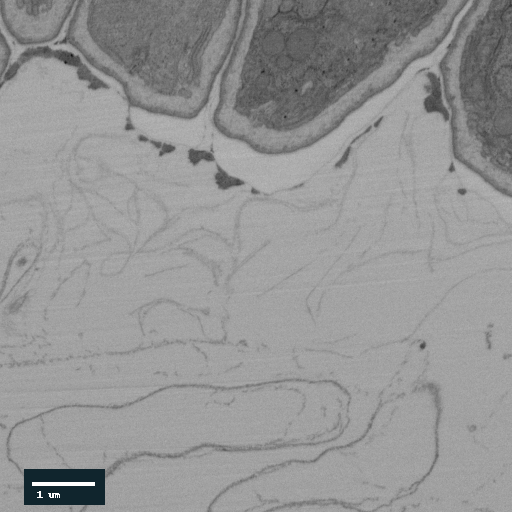
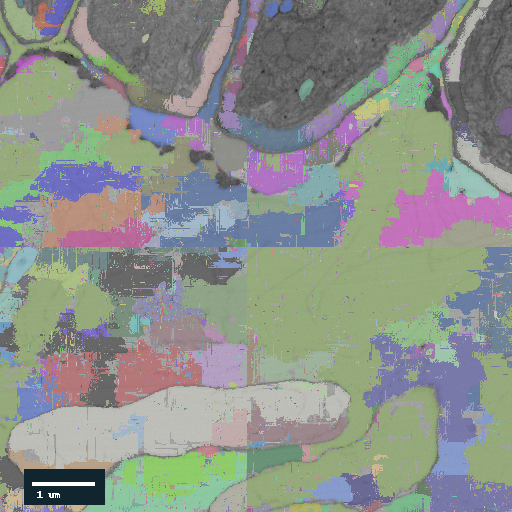
Colors indicate predicted neuron IDs; unassigned voxels retain their grayscale appearance. Both views show the same location. A 2D slice shows local boundaries; ERL evaluates continuity through the 3D volume.
Data: MaleCNS / FlyEM collaboration · CC BY 4.0 · Prediction: track FFN baseline.
Where does the reference data come from?
MaleCNS means the male fruit fly’s central nervous system. The released EM and reconstruction dataset [4] comes from a collaboration involving FlyEM at HHMI Janelia, the University of Cambridge, MRC Laboratory of Molecular Biology and Google Research. Training uses reference-derived supervision; evaluation uses held-out spatial regions. Region-level separation does not guarantee disjoint neuron identities.
MaleCNS dataset02How continuity is evaluated
Expected Run Length (ERL) measures the length of correctly reconstructed reference segments, weighted toward longer segments.
The ideal denominator
Assign each reference point its true neuron ID and run the same scorer. For paths of length 6 and 4:
This is a reference-based normalization, computed directly from the given skeleton.
The intuition
Imagine a uniformly chosen point along the total reference path. A length-6 neuron receives 60% of the weight; a length-4 neuron receives 40%.
ERL is calculated from all reference lengths; the random-point view explains the weighting.
How splits, merges and omissions affect ERL
A predicted ID spanning two reference neurons is treated as a merge; edges assigned to that ID contribute zero correct length. Edges touching ID zero are omitted. Edges crossing predicted IDs are split. Correct edge lengths are grouped by reference-neuron/predicted-ID pair.
Writing Lᵢ for each reference neuron’s length and Cᵢ,ₛ for correct length in a group: ERL = Σ Cᵢ,ₛ² / Σ Lᵢ. [5]
03The reference pipeline
The pipeline combines an initial Flood-Filling Network (FFN) with learned proposals and shape-based decisions inspired by PATHFINDER. [1] [2]
FFN
Grow neuron fragmentsStarting from seeds, the network repeatedly expands a neuron mask using image evidence and its current mask.
SENSE
Find candidate connectionsA 3D segmentation network identifies potential continuation regions and proposes fragment pairs.
SHAPE
Score the combined geometryA point-cloud classifier evaluates whether two fragments form a plausible neuron. Accepted pairs are merged. [3]
04Model architecture and scale
The models combine recurrent mask growth, dense 3D prediction and point-cloud classification. [6]
FFN
1.11M parametersSmall network, repeated spatial decisions. The 33³ network field of view moves inside each much larger FFN window.
SENSE
5.02M parametersLarge dense activations at every candidate center. Each crop contains about 58× as many voxels as one FFN crop.
SHAPE
8.19M parametersSHAPE has the most parameters of the three models and evaluates a small candidate set. Sampling and nearest-neighbor search add geometric work.
05Spatial context and reconstruction windows
The scored center is 512³ voxels. Shape reasoning needs surrounding anatomy, so reconstruction covers 1762³ voxels on a 16 nm grid.
Why reconstruct 40.76× the scoring volume?
The SHAPE context radius is 10 μm, equivalent to 625 voxels on each side at 16 nm resolution. Thus 512 + 2 × 625 = 1762, and (1762 / 512)³ = 40.76. This anatomy context is distinct from the 32-voxel overlap used to stitch FFN windows.
06Simplifications relative to PATHFINDER
The track preserves the proposal-and-repair structure while reducing ensemble and combinatorial work.
| Component | PATHFINDER paper pipeline | Track baseline |
|---|---|---|
| Initial reconstruction | 3 FFN weight sets × 2 seed orders; consensus | 1 corrected checkpoint; ascending seed order |
| Proposal comparison | Traditional FFN comparison uses independent proposals | FFN resegmentation and SHAPE receive the same 36 SENSE pairs |
| Merge search | Also evaluates combinations of 3 or 4 fragments | Disjoint binary merges; each initial fragment used at most once |
Once A–B is accepted, B is occupied and B–C is skipped. Multi-fragment search can also evaluate the joint candidate {A, B, C}.
What does “ascending seed order” mean?
Seeds are positions where FFN begins growing an instance. Ascending order sorts coordinates lexicographically by (z, y, x) within each window. An earlier reconstruction can occupy voxels and change what later seeds can grow into. The descending variant reverses this list.
07Measured reconstruction results
One fixed test context and one corrected FFN checkpoint. Both repair branches use the same candidate list and reference scorer.
| Method | Normalized ERL ↑ | Split count ↓ | Merge count ↓ |
|---|---|---|---|
| FFN baseline | 0.0000367474 | 3,993 | 5,047 |
| FFN + shared proposals | 0.0000367474 | 3,993 | 5,047 |
| FFN + SHAPE | 0.0000366064 | 3,984 | 5,047 |
−0.3837% relative nERL
A small decrease after SHAPE. Fewer splits did not translate into higher length-weighted continuity. Stability across independent training seeds remains unmeasured.
Weak base + limited repair reach
Very low starting continuity and only 36 repair candidates limit the opportunity for recovery. Candidate distribution mismatch and false-positive merge decisions are hypotheses requiring per-candidate analysis.
FFNv1.5 agglomeration → PATHFINDER, reported on the paper’s mouse IBEAM-mSEM benchmark. [1]
The paper demonstrates the potential of morphology-guided reconstruction repair. Its mouse benchmark provides research context; the fruit-fly evaluation uses different data and evaluation conditions.
08Interpreting the training signal
Dice is foreground F1.
Selected validation Dice: FFN 0.8335 · SENSE 0.5231.
SENSE’s first six validations, through 24.25 min, had zero Dice at a 0.5 probability threshold. BCE still fell from 0.605 to 0.021; Dice reached 0.282 at 29.09 min. Probability learning can precede thresholded foreground overlap.
70.31% accuracy needs context.
45 of 64 balanced validation examples were correct. Only 13 of 32 invalid pairs were rejected.
One example changes accuracy by 1.56 percentage points. This diagnostic uses threshold 0.5; final merging uses 0.8. Accepted-merge precision at the deployment threshold needs separate measurement.
09Compute and memory
Training and downstream repair, starting from a precomputed FFN segmentation.
About 6 hours elapsed across three sequential training stages.
Domain training: 24.0 GPU-h + 0.1 GPU-h overhead.
1 h 26 min elapsed · up to 28 GPUs concurrently.
GPU-hours = allocated GPUs × elapsed time.
FFN growth + overlap stitching
Precomputed segmentationSENSE evaluates eligible centers
32.2 GPU-hSame list to both repair branches
0.4 GPU-h combinedMemory and storage
| Resource | Usage | Configuration |
|---|---|---|
| FFN training GPU memory | 4.8 GB peak allocated | Batch size 16 per GPU |
| SENSE training GPU memory | 11.5 GB peak allocated | Batch size 8 per GPU |
| Storage footprint | 71.5 GB sampled peak | Data, models, intermediate results and runtime files |
10Research directions
Long-range identity
Train and validate for continuity across thin branches, ambiguous boundaries and window seams. Pair mask metrics with topology-aware validation.
Calibrated repair
Measure candidate recall and accepted-merge precision on actual predicted fragments. Study higher-order candidates and train on realistic failure cases.
Efficient inference
Batch FFN growth updates, schedule windows by estimated work, and reuse image features and candidate geometry. Verify reconstruction equivalence when optimizing.
Context and memory
Use chunked scoring, spatial indices and streamed point clouds. Smaller scoring cores alone save limited work when wide anatomy context dominates volume.
11References and provenance
Accelerating neuron reconstruction with PATHFINDER
Januszewski, Templier, Hayworth, Peale & Hess · bioRxiv, 2025
Source for SENSE, SHAPE, the multi-fragment reconstruction pipeline, and the paper’s mouse-benchmark comparison.
High-precision automated reconstruction of neurons with flood-filling networks
Januszewski et al. · Nature Methods, 2018
Foundation for iterative, mask-conditioned neuron growth. The track uses an independently reconstructed, 20-block FFN v1.5-style architecture.
PointNeXt: Revisiting PointNet++ with Improved Training and Scaling Strategies
Qian et al. · NeurIPS, 2022
Model-family reference for SHAPE. The six-stage classifier, widths and training setup are track-specific choices.
Sexual dimorphism in the complete Drosophila male central nervous system connectome
Berg et al. · Cell, 2026
Scientific context for the MaleCNS image and reconstruction dataset used to prepare this track’s supervision and evaluation references.
FunkeLab / funlib.evaluate
ERL scoring, including merge, split and omission handling.
AI4Sci fruit-fly reconstruction track
Model definitions, experimental protocols, results and compute measurements. The models are trained on the track data; architectural and protocol differences limit direct comparison with the paper.
October 2026.
Leaderboard
SimulatedDesign preview · leaderboard values and research histories are simulated.
| # | Method | Type | Segmentation IoU ↑ | Neuron recall ↑ | Topology agreement ↑ | Research time | Run |
|---|---|---|---|---|---|---|---|
| 1 | Agent search | 0.7646 | 0.4728 | 0.6338 | 76 h | ||
| 2 | Agent search | 0.7636 | 0.4722 | 0.6330 | 60 h | ||
| 3 | PATHFINDER (single-checkpoint FFN / SENSE / SHAPE) | Reference | 0.7600 | 0.4700 | 0.6300 | — | — |
How to read these leaderboard metrics
These leaderboard values and research histories are simulated design examples. The leaderboard is ranked by Segmentation IoU. The research curves show relative improvement in this metric over PATHFINDER (single-checkpoint FFN / SENSE / SHAPE); only accepted new-best results update the retained trajectory. A positive gain means a better result, with the sign adjusted for metrics where lower is better. The reconstruction task and measured experiment use nERL; the preview IoU, recall and topology columns do not report those experiment results.
- Segmentation IoUPrimary metric · Higher is better
- Intersection over union between predicted and reference segmentation regions. It measures spatial overlap, not whether neuronal connectivity is preserved.
- Neuron recallHigher is better
- The share of reference neurons recovered under the evaluation’s matching criteria.
- Topology agreementHigher is better
- Agreement between reconstructed and reference connectivity under the task’s topology comparison rules. It complements voxel-level segmentation metrics.
AI4AI research progress
Research trajectory
Runtime–performance frontier
How improvement is measured
Relative improvement over PATHFINDER (single-checkpoint FFN / SENSE / SHAPE) in the primary metric; only retained results update the best-so-far curve.
Accepted new-best experiments raise the trajectory. The frontier includes evaluated candidates; trial, partial and stopped experiments are excluded.