
Crystal Structure Generation
Generate candidate crystal structures and evaluate their stability.
Task & evaluation
- Objective
- Learn to propose new inorganic crystals.
- Input
- A request for a batch of new structures.
- Output
- Elements, atomic positions and repeating cells.
- Data
- About 27,000 training crystals and 9,000 validation crystals from MP-20.
- Evaluation
- Count distinct, novel and energetically promising structures after physical screening.
- Research challenge
- Generate a diverse set of plausible arrangements, rather than variations on familiar crystals.
Understanding the task
Explore how a model proposes new atomic arrangements—and why a promising proposal must survive several different tests.
Can a model suggest a new crystal?
A crystal is a pattern of atoms repeated through space. Discovering a useful material means choosing both its ingredients and their arrangement: the same elements can form very different structures. This task asks a model to propose crystals without being told a desired property or given an existing structure to improve.
The challenge is to learn chemical regularities without simply copying familiar materials. A plausible-looking arrangement may collapse when atoms are allowed to move. A stable arrangement may already be known. A generator therefore needs both physical plausibility and diversity.
One cell, many candidates, one fixed denominator
Explore periodic coordinates, then follow a synthetic batch through relaxation and discovery screening. These diagrams are illustrations, not predictions from UMA or LeMat.
A real training crystal
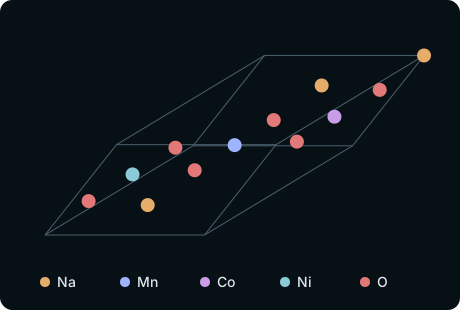
What the learned model changes
- Base stateChoose an atom count and start with uncertain elements, scattered positions and a rough cell
- A network reads the current proposalCombine element identities, positions and cell shape at each stage
- Three coupled predictionsChoose elements, move atoms across periodic boundaries, reshape the cell
- Gradually form a crystalUse the same learned model for every proposal
- Separate evaluatorUMA relaxation → LeMat validity, distinctness, novelty and hull checks
The generator learns to propose structures; a separate physical model checks and relaxes them.
A crystal repeats across its cell boundary
Twelve requests stay twelve requests
Select a candidate to inspect its cell. Change the stage to see schematic atomic displacements and the final outcome.
Benchmark setting: 2,500 proposals → physical relaxation → validity, novelty and stability screening. Reward = (SUN + MetaSUN) / 2,500. Strict SUN is reported separately; the schematic batch uses 12 only to make the arithmetic visible.
Learning from known materials
Training uses about 27,000 MP-20 crystals, each with at most twenty atoms in its repeating cell. Each example describes the elements, atomic positions and cell shape. The real example above contains sodium, manganese, cobalt, nickel and oxygen; repeating its cell produces the larger solid.
Positions are expressed relative to the cell. An atom leaving one side reappears at the opposite side, so an ordinary straight-line distance can be misleading. The interactive example shows why a crystal model must understand periodic boundaries. Models learn from scratch; external structures and pretrained generators are excluded.
What counts as a discovery?
Every method proposes 2,500 structures. The evaluator relaxes them and checks whether they are valid, different from each other, absent from a reference collection, and energetically competitive. Energy above the convex hull measures whether a crystal could lower its energy by separating into competing phases.
The score counts stable and metastable structures that are also unique and novel. Metastable means close enough to stability under the screening rule; it does not mean experimentally demonstrated. Failed proposals still count among the 2,500 requests. These are model-based screening judgments, not confirmation by synthesis or fresh quantum calculations.
Turning a rough proposal into a structure
The OMatG reference begins with uncertain atom identities, scattered positions and a sampled cell. A neural network gradually changes all three into a crystal-like arrangement. During training it sees intermediate states between rough starting points and real crystals, and learns how to move toward the latter.
These changes must stay coordinated: changing the cell alters the real distance between atoms, while changing an element alters which neighbors are plausible. Periodic position updates keep motion continuous across cell boundaries. A separate, fixed physical model then relaxes each proposal by moving atoms and the cell toward lower energy.
That separation matters. If relaxation does most of the useful work, even an untrained proposal generator can perform surprisingly well. Comparing with a generator based only on training-set statistics helps reveal what the learned model contributes.
More candidates, but mostly metastable ones
The learned generator raises combined discovery yield from about 11% to 21%. Yet strict stable discoveries fall slightly, from 0.88% to 0.60%. Most of the gain therefore comes from metastable candidates, not from finding more strictly stable materials.
Validity and diversity also improve, but these summary statistics do not establish which change caused the gain. Only one generation seed is reported. Repeating the comparison would show how much the result depends on sampling.
| Generator | Stable + metastable discoveries | Strictly stable discoveries |
|---|---|---|
| Untrained statistical generator | 10.6% | 0.88% |
| Learned OMatG generator | 20.8% | 0.60% |
Compute and resources
Training and candidate screening
Reported measurement
- Time
- ≈8 h 21 min
- Hardware
- 6 × H100 training and relaxation; 8 × H100 scoring
- GPU allocation
- ≈53.5 GPU-h (derived)
Reported stages for the reference model.
Elapsed time by stage
- Training
- 324 min
- Relaxation
- 74 min
- Ensemble scoring
- 103 min
Allocation derived from each stage’s GPU count × time. Generation and data preparation are not reported and are excluded.
Timing and hardware details
Generator training
Reported measurement
- Time
- 5.4 h
- Hardware
- 6 × H100
- GPU allocation
- ≈32.4 GPU-h
One recorded training run.
Candidate screening
Reported measurement
- Time
- 2 h 57 min
- Hardware
- 6–8 × H100
- GPU allocation
- Not separately reported
Relaxation and scoring of 2,500 proposed structures.
Elapsed time by stage
- Relaxation
- 74 min
- Ensemble scoring
- 103 min
Relaxation uses six GPUs; scoring uses eight. Generation and data preparation are excluded.
What would make the result stronger?
A useful next experiment would measure how far relaxation moves each proposal. Good starting structures should need less repair while retaining diversity. Testing several sampling settings could reveal whether higher yield comes from broader exploration or repeated variations on a few easy families.
The scientific goal is a supply of distinct, promising candidates for more accurate calculations and experiments. Better screening scores are a step toward that goal, rather than its final proof.
References and provenance
Open Materials Generation with Stochastic Interpolants
Describes OMatG, the generative method that learns to assemble periodic crystal structures.
Crystal Diffusion Variational Autoencoder for Periodic Material Generation
Introduces the crystal-generation setting associated with MP-20, the training structures used here.
LeMat-GenBench: A Unified Evaluation Framework for Crystal Generative Models
Provides the screening framework for assessing generated crystals.
Task definition and experimental evidence
Defines the fixed relaxation and screening procedure used for this task. Scores from different relaxation protocols are not directly comparable.
Code links require access to the project’s GitHub repository.
Leaderboard
SimulatedDesign preview · leaderboard values and research histories are simulated.
| # | Method | Type | SUN + MetaSUN ↑ | Validity ↑ | Uniqueness ↑ | Research time | Run |
|---|---|---|---|---|---|---|---|
| 1 | Agent search | 0.5890 | 0.4984 | 0.6595 | 76 h | ||
| 2 | Agent search | 0.5874 | 0.4970 | 0.6577 | 60 h | ||
| 3 | OMatG CSPNet (Linear-SDE-Gamma) | Reference | 0.5850 | 0.4950 | 0.6550 | — | — |
| 4 | Element / density statistical generator | Reference | 0.4797 | 0.4059 | 0.5371 | — | — |
How to read these leaderboard metrics
These leaderboard values and research histories are simulated design examples. The leaderboard is ranked by SUN + MetaSUN. The research curves show relative improvement in this metric over OMatG CSPNet (Linear-SDE-Gamma); only accepted new-best results update the retained trajectory. A positive gain means a better result, with the sign adjusted for metrics where lower is better. The task protocol is described in Task & evaluation above. These preview columns and trajectories are not measured benchmark results and must not be compared with the recorded experiments. Leaderboard rows and research curves below are simulated interface examples, not the measured CrystalGen results. The verified OMatG starter reaches 0.208 and the smoke generator 0.106 on 2,500 requests; see Measured reference results. Actual evaluation reports strict SUN and MetaSUN separately after fixed UMA-200 relaxation.
- SUN + MetaSUNPrimary metric · Higher is better
- The combined stable, unique and novel crystal-generation measure used by the task. Candidates are assessed after the prescribed relaxation; strict SUN and the broader MetaSUN criteria must be interpreted separately.
- ValidityHigher is better
- The fraction of generated candidates that satisfy the task’s structural validity checks. Validity alone does not establish stability or novelty.
- UniquenessHigher is better
- The fraction of generated candidates remaining distinct under the task’s duplicate-matching rules.
AI4AI research progress
Research trajectory
Runtime–performance frontier
How improvement is measured
Relative improvement over OMatG CSPNet (Linear-SDE-Gamma) in the primary metric; only retained results update the best-so-far curve.
Accepted new-best experiments raise the trajectory. The frontier includes evaluated candidates; trial, partial and stopped experiments are excluded.